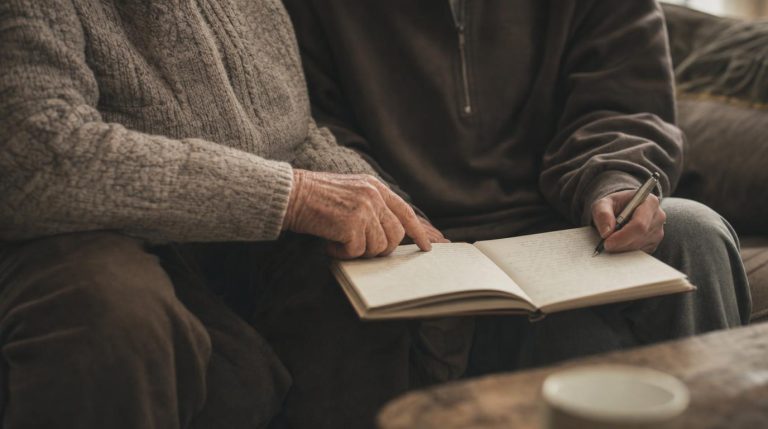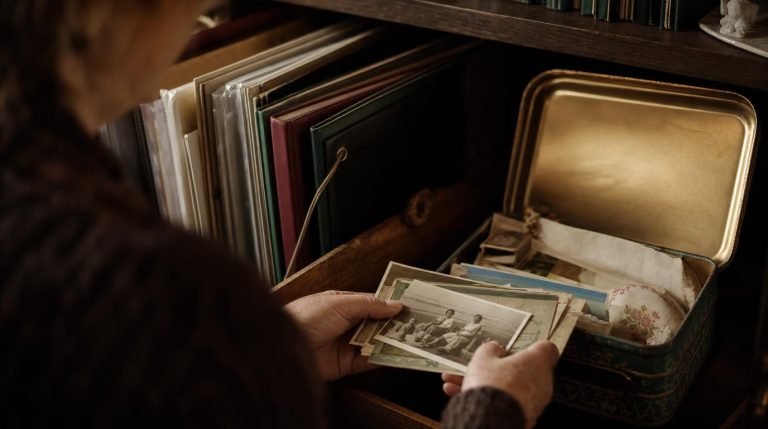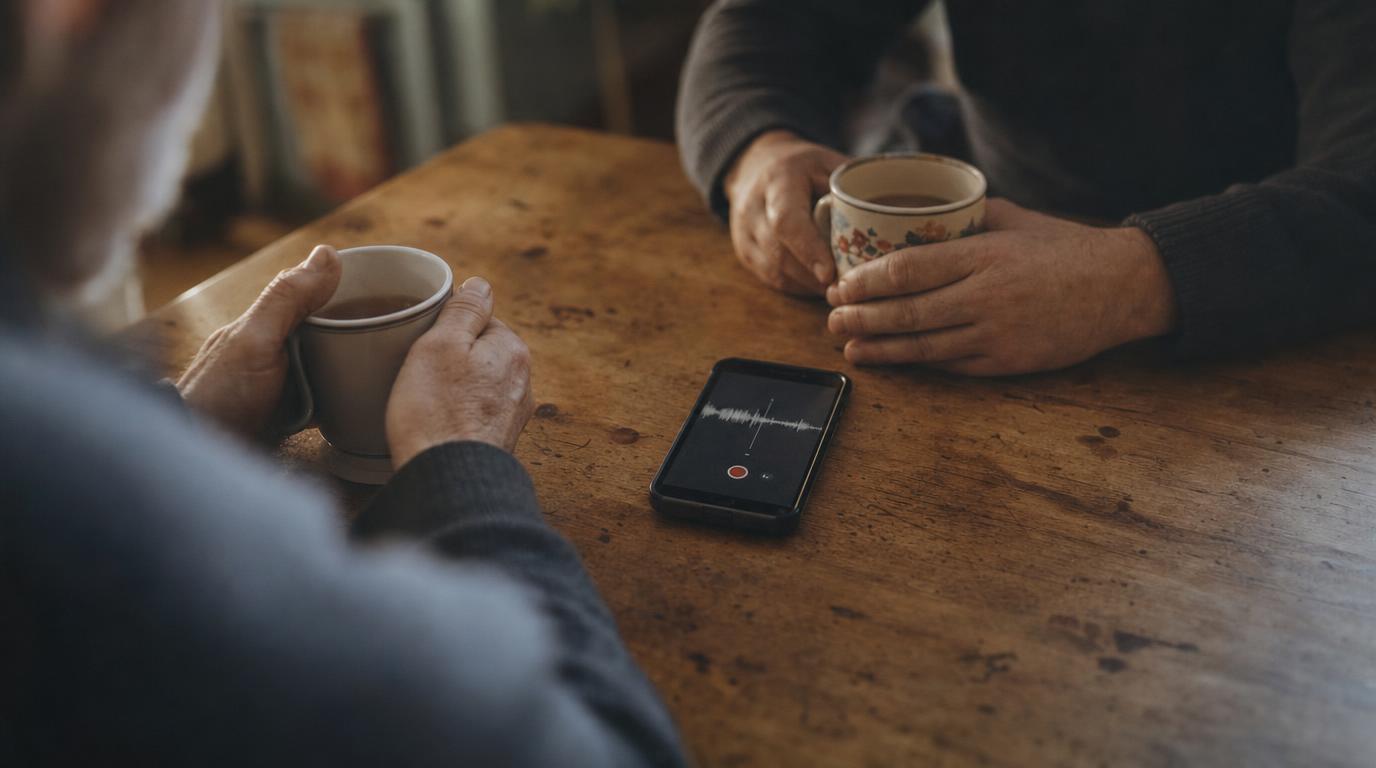
You do not need special kit, a quiet studio, or any experience at all. A modern phone records perfectly good sound, and the person in front of you already holds the one thing that matters: their story. This guide walks you through the whole thing, from the first question to backing up the file.
It is worth doing sooner rather than later. The recordings people treasure most are almost always the ones they nearly did not make.
- A smartphone, any make from the last few years
- A quiet room with soft furnishings
- Six to eight questions ready to go
- About an hour, unhurried
- Somewhere to back the recording up afterwards
The six steps
Choose your person and your moment
Start with the oldest voice in the family, or the one whose stories feel most at risk of being lost. Age is the honest reason to begin there: memories and voices do not wait.
Pick a time when neither of you is rushed. After a meal, on a slow afternoon, or in the evening once things have quietened down all work well. Tell them beforehand what you would like to do, so it does not feel like an ambush. Most people are quietly delighted to be asked.
Keep the first session to an hour or so. You can always record again, and a tired session is worse than a short one.
Prepare your questions
Six to eight open questions are plenty. Open questions ask what something was like; closed ones can be answered with a yes or a no. “What was your street like when you were small?” opens a door. “Did you like your street?” closes it.
Order them gently. Begin with easy, factual ground, then move towards the deeper questions once they have warmed up. You do not have to stick to the list, and you should not try to. It is there to catch you if the conversation stalls, nothing more.
Set up to record
The voice recorder app that came with your phone is all you need. On an iPhone it is Voice Memos; on Android it is usually Recorder. Open it, rest the phone on something soft such as a cushion or a folded cloth about a foot from whoever is speaking, and press record.
Put the phone into airplane mode first so a call cannot interrupt you, and do a twenty-second test, then play it back to check you can hear clearly. If you would rather keep the face as well as the voice, stand the phone up in landscape and film instead. Families treasure that even more.
Check you have enough storage before you start, and switch off any fan, television, or radio. Background hum is the one thing you cannot fix afterwards.
Start gently and listen
Open with something easy and warm: where they were born, the house they grew up in, who was at home. Then mostly listen. The hardest and most important skill is to leave silences alone. People often say the truest things a few seconds after they seem to have finished.
Nod, show you are following, and resist the urge to correct a date or fill a gap. You are gathering their version, in their words. That is the whole point of it.
Follow the feeling, not the script
When their face lifts, their voice softens, or they laugh, that is the story. Put the list down and follow it. “What happened next?” and “How did that feel?” and “Who else was there?” will take you further than anything you planned.
If they become emotional, that is not a problem to fix. Let them have the moment, offer a cup of tea, and carry on when they are ready. Those passages are often the ones families come back to most.
Save it properly
The moment you finish, back the recording up somewhere safe, and do it in two places, not one. Then write down the date, who is speaking, where you were, and anything you want to remember about the session.
A file called “New Recording 47” helps nobody. Name it clearly, something like “1954-Nan-childhood-Aston”, and it will still make sense to someone opening it in fifty years. Our guide on building a family archive shows you how to keep it all in order.
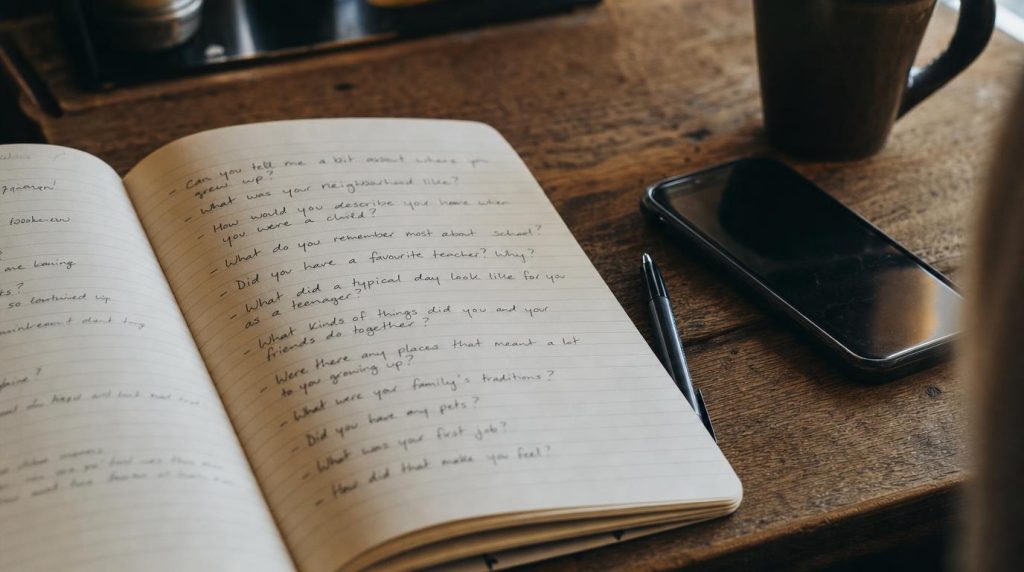
Prompts to help
If the conversation ever stalls, reach for one of these. You will rarely need more than a handful in a sitting.
Beginnings. Where were you born, and what was home like? Who were you closest to as a child? What did an ordinary day look like?
Working life. What was your first job, and your first wage? What work are you proudest of? Who taught you the most?
Love and family. How did you meet? What do you remember about your wedding day? What surprised you most about becoming a parent?
Hard times. When was money tightest, and how did you manage? What got you through the worst of it? Who could you always rely on?
Looking back. What are you most proud of? What would you do differently? What do you hope we remember about you?
Common questions
Do I need a proper microphone?
No. A phone from the last few years records more than well enough for a spoken conversation in a quiet room. Save your money for a cup of tea and a biscuit instead.
What if they do not want to be recorded?
Never push it. Ask if you can simply take notes, or record only the audio and not video, which many people find less daunting. Often the recorder is forgotten within minutes once the talking starts.
What if they become upset?
Let them. A pause, a cup of tea, and a gentle “we can stop whenever you like” is all that is needed. Only ever record what the person is happy to share.
How long should it be?
An hour is plenty for one sitting. Several shorter sessions beat one marathon, and give you both time to remember more between them.
Should I write it down as well?
It helps. A short written summary, with names and dates, makes the recording far easier to find and understand later. Some people also have the audio transcribed into text.